Total Pageviews

Canada's Leacock Medal for Humour


Review - 2026 She's a Lamb! Meridith Hambrock

Review - 2025 I Hope This Finds You Well by Natalie Sue

Review - 2024 The Librarianist by Patrick deWitt

Review - 2023 Jennie's Boy by Wayne Johnston

Review - 2022 Mercer Memoir

Scroll Down for Pocasts


1991 Writing in the Rain by Howard White 

Interview with HOWARD WHITE about his book on BC coastal life.  


Click Here for Audio

And Here for Transcript 


1985 Love is a Long Shot by Ted Allan                                                  

Interview with LITERARY HISTORIAN BRIAN BUSBY on whether the book should have won the Leacock Medal 


Click Here for Transcript


1983 The Outside Chance of Maximillian Glick                                                  

Part II of Interview with author MORLEY TORGOV 


Click Here for Audio

Click Here for Transcript


1982 Gophers Don't Pay Taxes by Mervyn J. Huston


1979 True Confections by Sondra Gotlieb

Interview with SONDRA GOTLIEB about book and her life


Click Here for Audio

Click Here for Transcript


1975 A Good Place to Come From by Morley Torgov 

Part I – Interview with author MORLEY TORGOV 

(See Part II of the interview above)

 Click Here for Audio


Click Here for Transcript


1970 The Boat Who Wouldn't Float by Farley Mowat 

Interview with CLAIRE MOWAT 
about her personal connection to her husband’s book.


1965 War Stories by Gregory Clark 


Interview with author's great-nephew, television journalist 

TOM CLARK 


Click Here for more on Gregory Clark and War Stories


Click Here for Transcript


1964 Homebrew and Patches by Harry J. Boyle


Click here for Audio Podcast


1962 Jake and The Kid by W.O. Mitchell


1956 Shall We Join the Ladies by Eric Nicol

Click Here for Audio Podcast 


1954 Pardon my Parka by Joan Walker 

Click Here for Transcript of Podcast


Click here for Youtube Review of Pardon My Parka Review


1953 The Battle of Baltinglass by Larry Earl


1952  The Salt-Box by Jan Hilliard


Click here for Podcast

Interview with Yarmouth, N.S. local historian and educator 
David Sollows about the authenticity of the book, the process of looking back with affection and humour, and his surprising personal connections to the book.


1951  The Roving I by Eric Nicol

Interview with B.C. WRITER TOM HAWTHORN
whose works include tributes to Nicol

Click Her for Audio

Click Here for Transcript


1950 Turvey by Earle Birney 


Interview with
PROFESSOR ELSPETH CAMERON, 
Birney's biographer. 


Click Here for Audio 

Click Here for Transcript 


1949 Truthfully Yours by Angeline Hango 


Interview with
Humour-writing scholar
DR. JEANNE MATHIEU-LESSARD

Click Here for Audio

Here for Transcript


1948 Sarah Binks by Paul Hiebert  


Interview with
JOEL SALT - UNIVERSITY OF SASKATCHEWAN
the Hiebert Digital Collection
PROFESSOR TOM SYMONS
about 
his father's book Ojibway Melody.

The Cruelty and Kindess of She's a Lamb - 2026

Stephen Leacock defined humour as “the kindly contemplation of the incongruities of life and the artistic expression thereof.”

Readers of She's a Lamb!, the novel honoured with the award established in the revered humorist’s honour (the 2026 Stephen Leacock Memorial Medal for Humour), might not immediately think of the word “kindly.”

In the opening chapters, narrator and aspiring musical theatre performer Jessamyn St. Germain surveys the world around her with a ferocity that would make even the sharpest satirist wince. Fellow auditioners are “wannabes” and “aging women” whose careers constitute cautionary tales, complete with “makeup caked over discount Botox.” A co-worker is “a troll.” Theatre patrons are “rubes.” A stagehand possesses an “orthopedic” body. An earlier evaluator was a “bitter old cruise ship musical assistant” and “obviously a talentless hack.” Passersby on the street are cultural dullards incapable of naming an opera. Her rival for the role of Maria in a Vancouver production of The Sound of Music is “the king bitch herself,” whose social media followers are “drooling, sugar-soaked Midwestern teenagers.”

Jessamyn, meanwhile, sees herself as committed, serious, talented and “a deeply attractive blonde woman.”

The stage is set for a novel fuelled by next-level snark, extravagant self-regard and delusion, all executed with remarkable comic precision. There is more than a little Carol Burnett channeling Norma Desmond in Hambrock's portrait of a performer convinced that stardom is her right.

The result is consistently funny.

And – increasingly - unnerving.

The acidic observations that initially delight gradually evolve into something darker. Jessamyn's private assessments become violent fantasies. Her magical thinking intensifies. The novel edges toward psychological suspense.  Still, the book holds on to its comic core.

The author Meridith Hambrock, who grew up in Ontario, studied creative writing and developed screenwriting skill at university and worked extensively in television as a story editor and writer.  In this and other work, she has had a particular fascination with what she calls “messy women” - female characters struggling to repair lives that are, or always have been, in shambles. That interest animated her earlier novel Other People's Secrets and reaches a new level here. As Hambrock herself has said, she loves story, character arcs, and momentum. This is clear in She's a Lamb! Her background in writing for small screens is also evident. The novel moves with the pace and engine of better television dramas: scenes arrive quickly, images linger, and inducements to ask, “What happens next?” fall on every page. The book's visual imagination, from children's rehearsals to backstage humiliations to the haunting final images, gives it an almost cinematic quality.

Yet beneath the dark comedy lies something surprisingly traditional.

She's a Lamb! is, among other things, a story that celebrates community.

That may sound odd for a book whose protagonist spends so much time disparaging everyone around her. But the theatre world Hambrock creates is itself a small town  - an ecosystem governed by rituals, hierarchies, gossip, rivalries, shared disappointments and dreams. The awkward traditions and eccentric inhabitants of this artistic community echo, in contemporary form, the interconnected, “kindly” world of Leacock's Sunshine Sketches of a Little Town.

In this regard, scholarly studies suggest that Leacock's notion of “kindly” may be better understood not simply as gentleness but as kinship: humour directed toward one's own kin or kind. The people of Mariposa, like the theatre workers of Hambrock's Vancouver, are flawed, self-important, and sometimes ridiculous. But they are also recognizably human.

Many previous Leacock winners have poked at the boundaries of humorous writing.  In Trevor Cole's 2011 winner Practical Jean, the protagonist's musings on mortality lead her to murder her friends, and Earle Birney's wartime classic Turvey often veers toward the crude and absurd. Birney, notably, founded UBC's celebrated creative writing program, where Hambrock later earned both her BFA and MFA degrees. Hambrock thus joins a distinguished lineage of UBC-connected humourists that includes Eric Nicol, a three-time Leacock winner, Canadian literary icon Pierre Berton, Birney, and others.

Last year's Leacock Medal winner, Natalie Sue's I Hope This Finds You Well, also featured a protagonist whose inner life was defined by bitter judgments of others. But Sue's novel ultimately arrives at reconciliation and mutual understanding.

Not so much with She's a Lamb!

The narrator Jessamyn never achieves the self-awareness readers might hope for. There is no neat redemption arc. No conventional happy ending. Yet Hambrock accomplishes something arguably more difficult. Through Jessamyn's words and actions, readers come to understand her. We see the wounded ambition, loneliness, insecurity, trauma, and desperation beneath the narcissism. We also come to recognize the broader communities she inhabits: struggling artists juggling second jobs, performers shaped by the reverberations of #MeToo, people managing fragile mental health, and a contemporary Vancouver of social media, vlogging, helicopter parenting, and precarious creative careers.

The humour emerges primarily through that classic source of laughter: incongruity. This shows in the gulf between Jessamyn's dark thoughts and her syrupy public interactions; between her exalted view of herself and the reality others perceive; between the grand narrative she has constructed about her destiny and the far messier truth. Hambrock populates this world with memorable supporting characters: a voice-coach-cum-therapist, a stalker-turned-boyfriend, a bartender with Broadway experience, and arch rival Samantha, whose apparent success masks vulnerabilities not unlike Jessamyn's own.

Character, indeed, may be Hambrock's greatest artistic strength. Her people often have more than a few dimensions. They can surprise. They change or seem to change. Most importantly, they feel both quirky and real thanks to the author's sometimes unkind but funny descriptions. 

That presumption that humour must always be kindly or gentle was even challenged by Leacock himself. Arcadian Adventures with the Idle Rich, a darker bookend companion to Sunshine Sketches, offered biting social satire aimed at privilege, vanity and self-deception. Yet Leacock retained a fragment of sympathy for his targets, recognizing that their fantasies often blinded them to richer possibilities.

So too does Hambrock.

Jessamyn St. Germain is frequently appalling. She is often delusional. At times she’s frightening. But by the novel's end, readers understand both her suffering and the damaged community that produced her.

That understanding – flowing from compassion but without excusing, cutting satire with cruelty mitigated by backstory - may be the deepest connection between She's a Lamb! and the model  Stephen Leacock established.

So, in giving Meridith Hambrock the award, the 2026 Leacock Medal judges have recognized a novel that honours that tradition while boldly and creatively updating it for our anxious, performative, hyper-social, and psychologically fraught times.

The What’s So Funny Book Collection

 75th Anniversary – 2022

Leacock Medal for Humour


The What’s So Funny Collection is a set of all books honoured by the Stephen Leacock Memorial Medal for Humour. It was assembled by Port Dover author Dick Bourgeois-Doyle in the process of research and writing his book on the history of the award and past-winners (What’s So Funny? Lessons from the Leacock Medal for Humour (Burnstown Publishing).   The collection, which includes many autographed, first edition versions is being exhibited the year to mark the 75th anniversary of the award.  


Books in the collection include.


The Best Laid Plans, Terry Fallis, 2008

Original Self-Published Version

The Best Laid Plans, the political satire, and its author Terry Fallis are widely celebrated today. The book not only won the 2008 Leacock Medal but also the 2011 Canada Reads competition. It was later developed as a TV series and a stage musical.  But Fallis was largely unknown before this success and had to publish the book at his own expense.  A publishing deal with McClelland & Stewart followed his Leacock Medal win and the book has since been reformatted and distributed widely.  This copy, autographed by Fallis in 2009, is one of those early self-published, print-on-demand versions.


Just Add Water and Stir, Pierre Berton, 1960

Review copy addressed to Eric Nicol

Vancouver columnist and three-time Leacock Medal winner Eric Nicol was a shy student at UBC in the 1940s.  He was enticed into writing for the student newspaper under a pseudonym proposed by the editor, the future icon of Canadian journalism Pierre Berton.  Berton gave Nicol the pen name “Jabez”, a biblical word meaning “he who causes sorrow.”  Years later when Berton himself won a Leacock Medal for his essay collection Just Add Water and Stir, he sent  one of the pre-launch review copies to Nicol with the inscription “For Jabez from an old admirer.” This is that book.


Leaven of Malice, Robertson Davies, 1955

First Edition/First Printing, signed

When Robertson Davies died in 1995, he was celebrated as one of Canada's most popular authors and distinguished “men of letters.”  He was a prolific novelist, playwright, critic, essayist, and academic. But when he wrote the 1955 Leacock Medal winner Leaven of Malice, his day job was as Editor of the Peterborough, Ontario Examiner, one of his family’s newspaper holdings. The book, the second in his trilogy of stories based in the imaginary town of Salterton, follows an adventure focused on the local newspaper editor.  This is a first-edition/first-printing copy of the book and carries Davies’ distinctive signature.


Ojibway Melody, Harry Symons, 1947

Self-Published version, signed

Ojibway Melody: Stories of Georgian Bay by Harry Symons was the inaugural winner of the Leacock Medal in 1947.  On the surface, the book may seem like a light-hearted and simple celebration of summers in Ontario cottage country.  But many scholars including the author’s son, Tom Symons who was the first president of Trent University, see deeper meaning, special tolerance, and caring in the book’s passages.  The book helped inspire the first academic programs in Canadian and Indigenous Studies.  This copy of the book was printed in the 1940s and was signed by the author two years before he died in 1962.


Sarah Binks, Paul Hiebert, 1948 

– Willows Revisited

Inscribed, Hand-written Poem 

Many consider Sarah Binks, the 1948 Leacock Medal winner, by University of Manitoba Professor Paul Hiebert to be iconic Canadian humour.  The book is a gushing, over-the-top mock biography wrapped around a collection of bad poetry. In it, the imaginary Sarah is celebrated as the greatest poetess in the history of Saskatchewan and an expert on farm animals. This first edition/first printing copy was signed by Hiebert for his friends Don and Helen Penner, a couple famous for their contributions to medicine.  This accompanying copy of Willows Revisited, Hiebert’s sequel to Sarah Binks, has a hand-written poem by the author in the back.


Sunshine Sketches of a Little Town,
Stephen Leacock

First Edition (1912) – Plus Frenzied Fiction (1917) signed by Leacock

Stephen Leacock was regarded as the most popular humorist in the English-speaking world at the height of his fame.  He was exceptionally prolific as a humour writer as well as being a respected professor of political economy.  His best-known work remains Sunshine Sketches of Little Town, the book of stories associated with his summers in Orillia, the town where the Leacock Medal award was initiated. This is a first edition, early printing of Sunshine Sketches which first appeared in 1912.  The book that carries Leacock’s signature is a first edition, first printing copy of Frenzied Fiction, published in 1917. 


Generica (Happiness), Will Ferguson, 2002
Signed First edition under original title

When, in 2002, Will Ferguson won his first of three Leacock Medals (the others were for Beauty Tips from Moose Jaw in 2005 and Beyond Belfast in 2010), he received the award for a book that, in a sense, no longer existed.  By the time the medal was awarded for the novel Generica, it had been rebranded by its publisher as the more accessible Happiness.  With this revised title, the book went on to best seller lists and bookstore shelves around the world. This copy is one of those printed under the original title and was signed by the author.


Turvey, Earle Birney, 1950

Signed, First Edition/First Printing plus
Revised 1976 Unexpurgated Edition

When celebrated educator and poet Earle Birney tried to get his WWII picaresque novel Turvey published in the 1940s, he struggled.  British and U.S. publishers didn’t appreciate all of the Canadian themes and references.  Canadian ones balked at the swearing and “army talk.” Birney finally acquiesced, and the book was published with the swear words edited out.  It went on to win the Leacock Medal in 1950, and it inspired radio plays and stage productions.  This is a signed copy of this original version of Turvey along with a colorful, 1976 revision with Birney’s original wording put back in.


The Boat Who Wouldn’t Float, Farley Mowat, 1970

Signed Postcard – Pipe

Environmentalist and writer Farley Mowat wrote close to 50 books, sold millions, and saw his works published in many languages.  Yet The Boat Who Wouldn’t Float, Mowat’s humorous account of his 1960s adventures sailing a leaky boat along the east coast of Canada had a special place in his hear.  It not only won the Leacock Medal in 1970, but also described his meeting Claire, the woman who would become his wife.  This 1971 hard copy of the book accompanies a postcard from Farley and Claire sent just prior to the author’s death at the age of 92 in 2014 as well as one of Farley’s pipes.


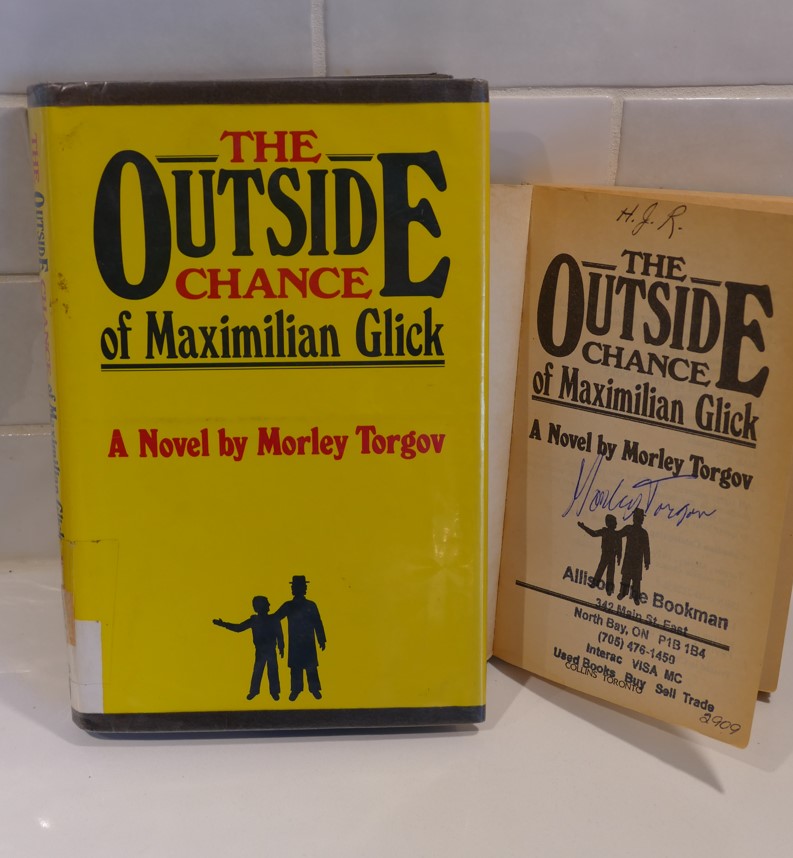
The Outside Chance of Maximillian Glick, 

Morley Torgov, 1983

First Edition, signed paperback

The 1983 Leacock Medal winner had a significant impact on Canadian culture as a portal on Jewish life in small town Ontario.  The author, Toronto lawyer Morley Torgov, drew upon his personal experiences as well as a true story to paint a vivid picture that inspired a popular motion picture as well as a TV series that made the name Maximillian Glick well known across Canada. This copy of the book is a first edition hard cover accompanied by a paperback version, published after the book had achieved its varied success and is autographed by the now 94-year-old author (2022).